

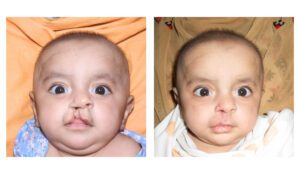
Breaking the Silence: Navigating the Realities of Cleft Lip and Palate in Pakistan
Every child deserves the right to smile, to speak clearly, and to eat without difficulty. Yet, every year in Pakistan, thousands of children are born with a cleft lip or palate—a congenital condition that affects not just a child’s face, but their entire future.
At the Muskurahat Foundation Pakistan Trust, we see these children not as statistics, but as individuals with immense potential. To truly understand the vital need for comprehensive cleft care, we must look at the real-world scenarios that families across Pakistan face every day.
Scenario 1: The First 24 Hours – The Nutritional Crisis
Imagine a mother in a rural village or a bustling urban settlement, holding her new born baby for the first time. Joy quickly turns to anxiety when she notices a gap in the baby’s lip or the roof of their mouth.
The immediate challenge isn’t cosmetic; it is survival.
* The Problem: Babies with a cleft palate often cannot create the suction required to nurse or take a standard bottle. Milk can easily enter the nasal cavity, leading to choking, inadequate nutrition, and severe weight loss.
* The Reality: Without immediate guidance on specialized feeding techniques or obturator plates, many of these infants suffer from severe malnutrition before they are even old enough for surgery.
Scenario 2: The Social Shadow – Isolation and Stigma
As the child grows into a toddler, a different kind of challenge emerges. In many parts of Pakistan, deep-seated myths and a lack of awareness surround congenital deformities.
* The Problem: Families are often subjected to cruel societal whispers. Mothers are sometimes unfairly blamed for the condition due to eclipses or “bad omens” during pregnancy.
* The Reality: Fearing judgment, parents may keep their child hidden at home. This early isolation chips away at a child’s self-esteem before they even understand why they are being treated differently. A cleft is a treatable medical condition, yet superstition often builds a wall around these families.
Scenario 3: The Classroom Hurdle – Speech and Education
By the age of five, a child should be preparing for school. However, for a child with an unrepaired or partially repaired cleft palate, this milestone can be daunting.
* The Problem: A cleft palate drastically alters speech development, often resulting in a hyper nasal voice that is difficult for peers and teachers to understand.
* The Reality: Even if a child undergoes a successful initial surgical repair, surgery alone does not instantly grant clear speech. Without access to long-term speech therapy, these children face severe bullying and academic struggle, often leading them to drop out of school entirely.
Beyond Surgery: The Need for Comprehensive Care
These scenarios highlight a crucial truth that drives our mission at Muskurahat Foundation: a cleft problem cannot be fixed by a single surgery alone.
True rehabilitation requires a dedicated, multidisciplinary ecosystem that walks with the child from infancy to adulthood.
Shaping New Futures, One Smile at a Time
The challenges in Pakistan are vast—ranging from financial barriers and geographical isolation to a shortage of integrated cleft centers. But where there is a challenge, there is also an opportunity to bring a Muskurahat (smile).
At the Muskurahat Foundation, we are committed to bridging these gaps. By providing free, holistic, and continuous care, we aren’t just operating on a lip or a palate; we are restoring a childhood, enabling an education, and lifting a burden off an entire family.
How You Can Help
Transforming a child’s life takes a village. Whether by spreading awareness to dispel cultural myths, volunteering, or supporting our comprehensive care programs, you can be the reason a child smiles tomorrow.
Join us in rewriting these scenarios. Let’s change a lifetime of isolation into a lifetime of opportunity.


Leave A Comment